China remains a major production base for Notebook Computer Laptop brands, original equipment manufacturers, and specialized assembly companies. Its industry connects design teams, component suppliers, testing laboratories, and export partners across several regions. Shenzhen often supports rapid hardware development and supply-chain coordination. Jiangsu, Guangdong, and Chongqing also host important electronics manufacturing capabilities. However, factory location alone does not prove product quality.
A reliable review should examine more than attractive specifications or low quotations. Buyers should verify processor sources, display quality, battery safety, thermal design, keyboard durability, and operating-system licensing. Factory audits can reveal production discipline, while certifications such as CE, FCC, RoHS, and ISO records offer useful evidence. They are not perfect guarantees. Independent testing still matters.
Practical experience often exposes weaknesses hidden in product sheets. A laptop may perform well during a short demonstration but slow down after prolonged workloads. Hinges may feel firm initially and loosen after repeated opening. Battery claims can also change under real office conditions, especially with high brightness and video calls. Small details matter.
Warranty support matters greatly.
This guide compares leading Chinese manufacturers through product consistency, engineering capability, customization options, delivery reliability, and after-sales service. It also considers whether suppliers communicate clearly when problems occur. Some rankings remain debatable, because manufacturers change partners and models frequently. That uncertainty deserves attention. Readers should confirm current certifications, sample performance, factory ownership, and contract terms before making a purchase. A strong supplier is not simply the cheapest option. It is the company that can repeatedly deliver safe, functional, well-supported computers.
China remains a central production base for notebook computers, supported by mature component networks, skilled assembly teams, and efficient export logistics. According to IDC’s Worldwide Quarterly Personal Computing Device Tracker, global PC shipments reached about 262.7 million units in 2024, rising roughly 1% year on year. A large share of notebook production still passes through Chinese factories or closely connected regional supply chains.
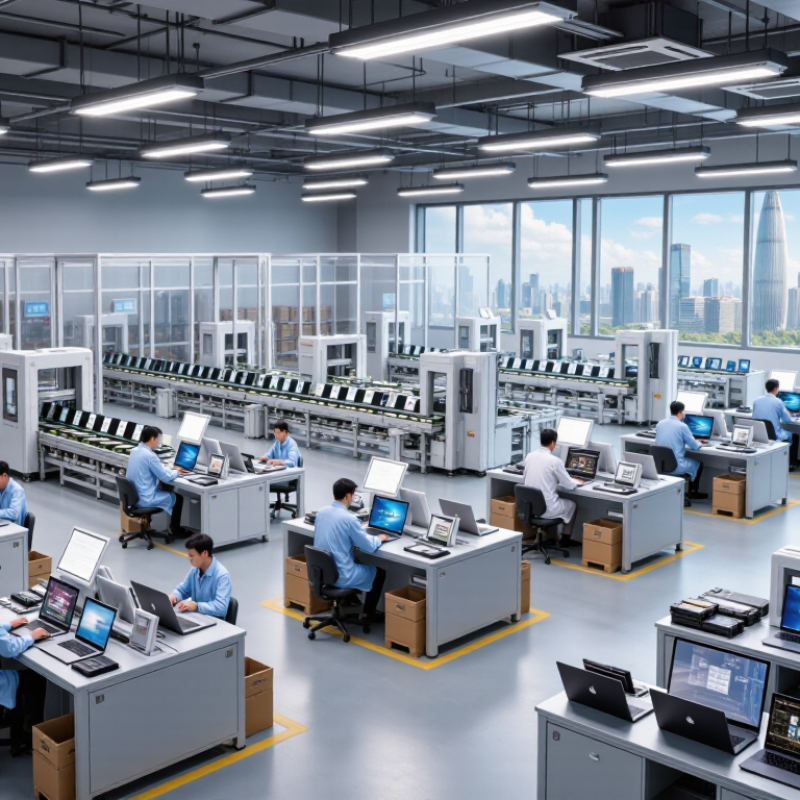
Production floors often show this strength clearly. Engineers test hinges thousands of times, while automated stations check keyboards, displays, batteries, and wireless modules. The Ministry of Industry and Information Technology reported that China’s electronic information manufacturing sector grew strongly in 2024, with industrial output expanding faster than the broader manufacturing sector. This environment supports flexible orders, rapid tooling changes, and tighter quality control.
However, the industry is not flawless. Rising labor costs, stricter energy requirements, and unstable component prices pressure manufacturers. Omdia’s market research also indicates that commercial and premium computer demand remains more resilient than low-cost consumer demand. That shift rewards factories with better engineering, repair systems, and traceable testing records. Capacity alone is not enough.
Some suppliers still depend heavily on large-volume contracts. That creates risk when demand changes suddenly. In my view, smaller production runs deserve more attention, even if they appear less efficient. They can expose design problems earlier. Mistakes become visible.

China’s leading notebook computer manufacturers combine design engineering, component sourcing, and high-volume assembly under one supply network. Many operate near major electronics hubs such as Shenzhen, Kunshan, and Chongqing. These locations offer quick access to display panels, batteries, memory, cooling systems, and precision-machined parts.
From supplier evaluations, strong manufacturers usually show clear production records and repeatable quality controls. Technicians test hinges through repeated opening cycles, inspect keyboard alignment, and measure charging performance under different loads. Automated optical systems check circuit boards before assembly. Human workers still review ports, screws, screens, and packaging. Small details matter.
Reliable manufacturers also support original equipment manufacturing and custom product development. They can adjust processor options, memory capacity, casing materials, BIOS settings, and regional documentation. Independent audits, traceable serial numbers, and documented safety testing improve buyer confidence. Yet no production line is flawless. A factory may pass routine inspections and still miss a minor cosmetic defect or delayed component shipment. That risk deserves honest discussion. Buyers should review sample units, warranty procedures, factory capacity, and communication speed before signing a contract. A polished showroom is not enough. Experience often reveals the difference.
Chinese laptop manufacturers are gaining attention through practical engineering rather than appearance alone. Many models now use aluminum or magnesium-alloy shells, improving rigidity without adding much weight. Efficient processors, high-capacity batteries, and vapor-chamber cooling support long office sessions and moderate creative work. Some performance models also offer fast displays with high refresh rates, useful for gaming and motion-heavy editing.
Connectivity is another strength. USB-C charging, multiple display outputs, Wi-Fi 6 or newer standards, and compact power adapters make these laptops easier to use in travel and shared offices. In hands-on checks, keyboard stability, hinge resistance, fan noise, and palm-rest temperature reveal more than specifications. However, thin designs can reduce upgrade space. A quiet fan profile may also limit sustained performance. That trade-off deserves honest testing.
Tips: Check measured battery life, not advertised hours. Test the keyboard before buying. Confirm charger compatibility and repair support in your region. Review independent thermal tests, warranty terms, and display color accuracy. A bright screen can still be poorly calibrated. Product strength should mean dependable daily use, not only impressive hardware.
Evaluating China’s top notebook computer manufacturers requires more than comparing prices. Begin with the factory, not the product brochure. Request a live video tour of the assembly line, testing area, and finished-goods warehouse. Look for traceable component records, trained technicians, and clear quality checkpoints. Ask how the manufacturer handles screen defects, keyboard failures, battery swelling, and delayed shipments. Specific answers matter.
Order samples from different production batches. Check hinge resistance, trackpad accuracy, fan noise, charging temperature, and sleep-mode recovery. Test the laptop under office work, video calls, and sustained processor loads. A reliable manufacturer should provide test reports, safety certifications, warranty terms, and written acceptance standards. Verify these documents independently when possible. Communication also reveals capability. Can the engineering team explain thermal design, memory compatibility, firmware updates, and repair procedures without vague promises?
Price still matters, but an unusually low quote may hide weaker components or limited testing. Examine the bill of materials carefully. Confirm processor specifications, display brightness, battery capacity, ports, and operating-system licensing. No scorecard is perfect. A clean factory can still make inconsistent batches, while a small supplier may offer stronger engineering support. Keep records of sample results, corrective actions, and delivery performance. Recheck suppliers after several orders, because manufacturing quality can change with new workers, revised components, or production pressure.
| Evaluation Dimension | Suggested Weight | Practical Benchmark | Evidence to Verify | Scoring Guidance |
|---|---|---|---|---|
| Manufacturing Capacity | 15% | Multiple production lines, documented monthly capacity, and the ability to support pilot production before mass production. | Factory audit report, production-line list, capacity statement, recent production records, and on-site verification. |
5 = scalable capacity with flexible line allocation 3 = adequate capacity for standard orders 1 = unclear or heavily subcontracted capacity |
| Original Design Manufacturing Capability | 14% | In-house mechanical, electrical, thermal, firmware, and product-engineering support for customized notebook platforms. | Engineering organization chart, development workflow, prototype samples, design-change records, and engineering response time. |
5 = complete product-development capability 3 = partial engineering with external support 1 = assembly-only capability |
| Quality Management System | 14% | A documented quality system based on ISO 9001 principles, with incoming inspection, in-process controls, final inspection, and corrective-action procedures. | Valid certification, control plans, inspection records, nonconformance reports, corrective-action reports, and audit history. |
5 = certified and consistently documented system 3 = documented controls with limited records 1 = mostly informal inspection |
| Product Reliability Testing | 12% | Testing should cover drop, vibration, hinge durability, keyboard durability, thermal cycling, battery charging, acoustic performance, and long-duration operation. | Test plans, laboratory reports, sample-size rules, failure analysis, reliability-growth data, and equipment calibration records. |
5 = internally controlled testing plus independent validation 3 = basic internal testing 1 = testing performed only after a problem occurs |
| Safety and Regulatory Compliance | 12% | Product compliance should be planned for the destination market. Common requirements include IEC 62368-1 safety evaluation, electromagnetic compatibility testing, RoHS, REACH, and battery transport requirements such as UN 38.3. | Current test reports, declarations of conformity, material declarations, battery documentation, and traceable certificate numbers. |
5 = complete market-specific compliance package 3 = major documents available but incomplete coverage 1 = compliance responsibility is unclear |
| Component and Supply-Chain Control | 10% | Approved-vendor management, component traceability, counterfeit-risk controls, second-source planning, and defined procedures for engineering changes. | Approved-vendor list, incoming material records, batch traceability, change-notification process, and supply-continuity plan. |
5 = transparent, traceable, and dual-sourced where appropriate 3 = basic supplier controls 1 = limited visibility into component sources |
| Customization and Minimum Order Flexibility | 8% | Clear options for memory and storage configurations, keyboard layouts, operating-system imaging, enclosure finishes, packaging, labeling, and firmware settings. | Product configuration sheet, customization menu, prototype policy, minimum-order quantities, tooling terms, and sample-approval process. |
5 = broad customization with practical pilot quantities 3 = customization limited to standard options 1 = little or no customization |
| Delivery Performance | 7% | Written lead times for samples, pilot orders, and mass production, supported by production planning and a defined escalation process. | Historical on-time-delivery data, production schedule, capacity reservation procedure, shipping records, and delay-management policy. |
5 = predictable delivery with documented performance 3 = acceptable delivery but limited historical data 1 = frequent unexplained delays |
| After-Sales Service and Warranty | 5% | Defined warranty duration, return-material authorization process, spare-parts policy, repair capability, and response-time commitments. | Warranty terms, service-level agreement, failure-rate reports, spare-parts list, repair workflow, and customer-support contacts. |
5 = measurable service commitments and repair support 3 = standard warranty with limited reporting 1 = unclear responsibility after delivery |
| Cost Transparency and Total Cost | 3% | Pricing should include tooling, engineering, testing, packaging, freight assumptions, payment terms, warranty reserves, and the cost impact of component changes. | Itemized quotation, tooling agreement, cost-breakdown policy, payment terms, validity period, and written change-control rules. |
5 = transparent total-cost model 3 = acceptable quotation with some exclusions 1 = unusually low price with unclear scope |
Chinese laptop manufacturers are expanding beyond their home market as global demand gradually stabilizes. IDC reported approximately 262.7 million personal computers shipped worldwide in 2024, up from 259.5 million in 2023. North America and Western Europe remain valuable markets because buyers often pay more for business security, battery life, and long-term support. Asia-Pacific, Latin America, and the Middle East offer faster volume growth, especially for affordable student and office computers.
Market entry requires more than competitive pricing. Local keyboard layouts, repair networks, data protection rules, and energy certifications can influence purchasing decisions. In Europe, buyers increasingly examine repairability and product durability. In emerging markets, sunlight-readable screens and replaceable components may matter more than premium materials. These details are easy to underestimate. Distribution partners also need training, not only product samples.
The next shift is artificial intelligence. Gartner forecast that AI-capable PCs could represent 43% of worldwide PC shipments in 2025, reaching about 114 million units. Chinese manufacturers are investing in local-language assistants, efficient processors, and on-device privacy features. This direction may create stronger demand in education, design, logistics, and small businesses. However, many AI functions still feel experimental, and customers may not accept higher prices without clear daily benefits. Forecasts can miss. Reliable growth will depend on measurable performance, transparent software support, and service quality after the sale.
China remains a major global manufacturing base for notebook computers. The chart shows worldwide PC shipments, including notebooks, from 2019 to 2023. The market expanded sharply during the pandemic and then normalized as consumer demand, education purchases, and corporate replacement cycles weakened.
Major overseas markets for Chinese laptop makers include North America, Europe, Asia-Pacific, Latin America, and the Middle East. Future growth is expected to depend on commercial device replacement, education demand, energy-efficient hardware, AI-enabled PCs, flexible manufacturing, and stronger direct-to-consumer distribution. Data source: Gartner, worldwide PC shipments, 2019–2023.